
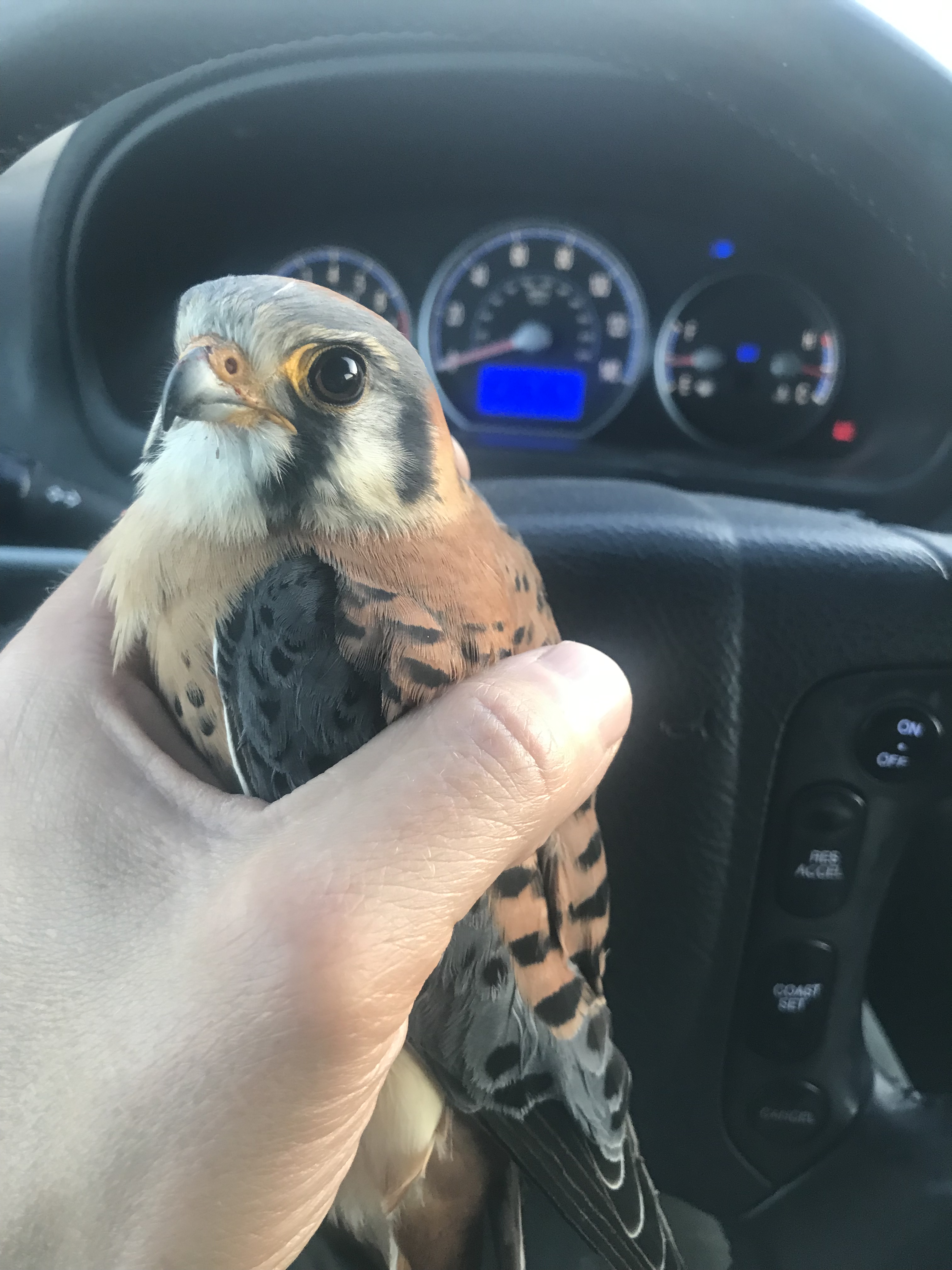
As I was driving back from a paleontology monitoring field assignment I passed through a rural area of mixed farms and houses. I was driving the speed limit and I swear I was watching the road carefully; but suddenly a bird dove in front of my car. I braked hard but heard the horrible sound of the animal bouncing off my windshield. I was hoping the little bird was merely stunned or injured, so I pulled to the shoulder, put on my flashers and ran back to the fluffy ball in the road.
The bird was still alive but not moving much, I picked him up carefully, tucking his wings into his body. It was an American Kestrel. I thought I’d drive him to a wildlife rehab about an hour away; so I climbed back into my car and got going. This is when the kestrel started to come a bit more aware and turned his head towards me. When those little eyes focused on me, I saw only his desire to tear my own eyes from my head. The little falcon’s head started dipping, the beak coming closer to tearing my flesh. This was a predator and seeing signs of violent tendencies was a good thing.
I enjoyed watching the spark of life return to the bird in my hand but I also wanted to end the day with said hand in tact. I quickly turned my car back and drove into a nearby school parking lot, nearly deserted at this hour. I walked towards a chain link fence bordering on a nearby field, a good place to hunt mice I figured. Then…
American Kestrels (Falco sparverius) are common throughout the US, using a broad range of habitats. Some populations that migrate also spend their summers in Canada and other permanent populations live in Mexico, the Caribbean and much of South America.
Where I usually see them is in rural to semi-rural areas, often near farms. When we drove across Nebraska to see Sandhill cranes, it felt like there were kestrels on every electrical pole for miles. Sadly, it seems the population of kestrels is dropping in the northeastern US but they seem to do well enough in our human disturbed world.
Kestrels hunt mice, grasshoppers, lizards, even flying bats. In a similar fashion to other predators, such as wolves, individual kestrels or groups of kestrels sometimes specialize in a particular prey. Bald eagles do this too sometimes.
Anyway, I was glad that the kestrel survived and I hope he’s thriving today. No matter how common, wildlife deserves our respect.

 ZachFitzner.com